Searching for hvac duct installers near me Oyster Bay, NY usually means one of two things: your rooms will not hold temperature, or your pre-war home has no duct system at all. This guide covers 2026 price bands for Nassau County, the Town of Oyster Bay permit steps most homeowners never hear about, and the questions that separate a real duct contractor from a crew that buries a mis-sized trunk behind your drywall. Read it before you accept the first quote.
What HVAC Duct Installers in Oyster Bay Actually Handle
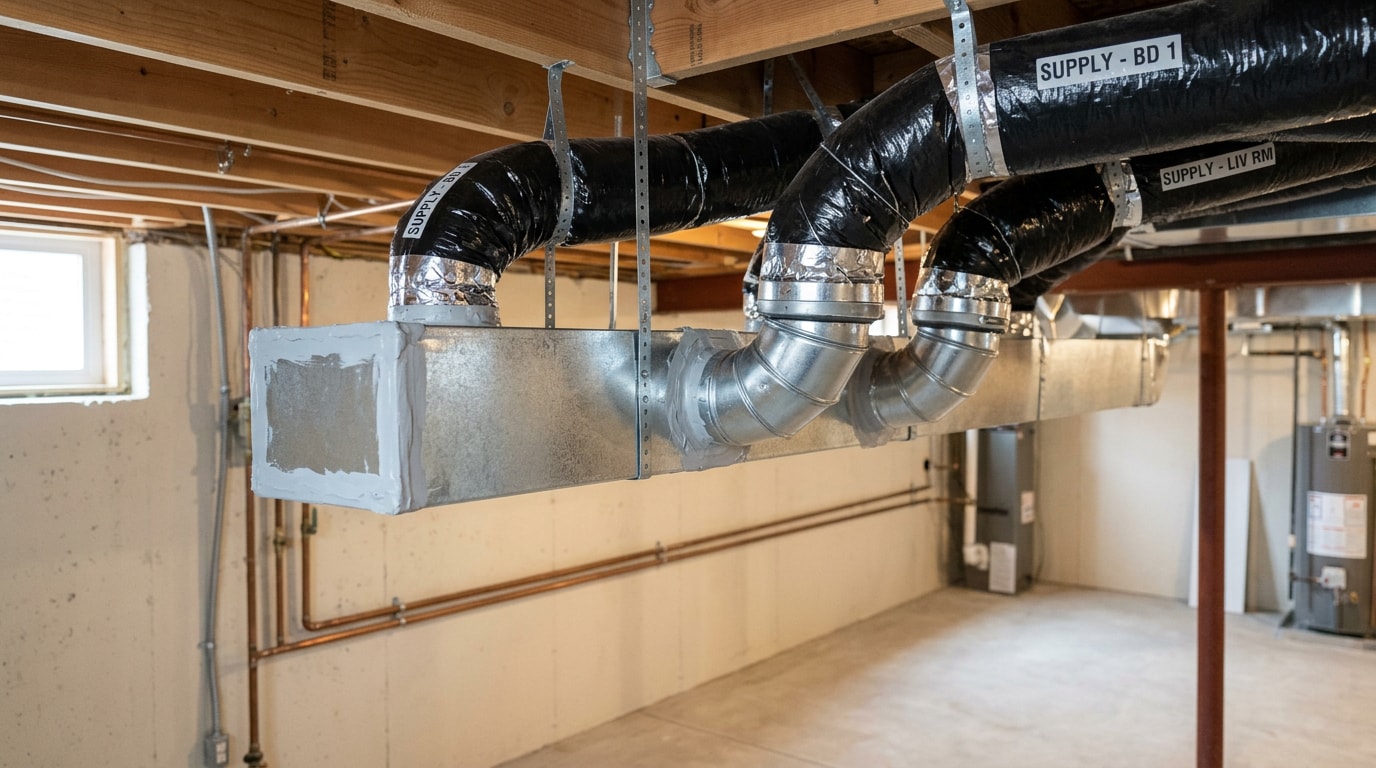
Duct work is a fabrication trade, not a parts swap. A full-service installer should cover all of the following:
- New duct systems for renovations, additions, and new construction
- Replacement of aging, damaged, or undersized systems
- Custom duct design, Manual J load calculations, and Manual D layout
- Modifications and extensions for finished basements and attics
- Duct sealing, insulation upgrades, and airflow balancing
- Retrofit routing for older homes with no existing chases
- In-house sheet metal fabrication of plenums, transitions, elbows, and takeoffs
- Commercial duct work for retail, office, and light industrial space
Shops that fabricate on site can match odd framing instead of forcing a stock fitting into a space that does not want it. On the Oyster Bay capes and colonials our crews work in most, the trunk almost never runs where the catalog says it should, and that is where field fabrication earns its keep.
Browse the full HVAC contractor service lineup or see finished work on our projects page.
How to Vet HVAC Duct Installers Near Me in Oyster Bay, NY
Vetting matters more on duct work than on an equipment swap. A mis-sized trunk gets sealed behind drywall and stays with the house for 30 years.
1. Verify the Nassau County license first
Duct installation is home improvement work, and Nassau County licenses the contractors who perform it. It is against the law to operate a home improvement business in Nassau County without a license, and you can call the Office of Consumer Affairs at 516-571-2600 to confirm a contractor is licensed and check the firm's complaint history.
The county's own consumer checklist says the contract should include the Nassau County Home Improvement license number in writing. Read the full Nassau County home improvement checklist before you sign anything.
Ask for a certificate of insurance naming you, not a photocopy from two years ago.
2. Confirm the installer pulls the permit
A reputable installer handles the Town filing and lists it as a line item. Permits are processed by the Town of Oyster Bay Building Division at 74 Audrey Avenue, with an annex in Town Hall South at 977 Hicksville Road in Massapequa, reachable at (516) 624-6200.
The Town also runs an online Building Division portal where registered contractors submit and track Fast Order and Instant permits, pay fees, schedule inspections, and monitor results.
Here is the detail almost no competing cost guide mentions: amendments cost money. The Town's published fee schedule shows no fee for a first amended building permit, $150 for a second, and $200 for a third or more.
Residential and commercial A/C and HVAC units also sit in a category requiring a certificate of compliance.
Translation: every mid-job change to your duct layout can trigger a paid amendment and a schedule slip. Lock the design before rough-in. Check current requirements with the Town of Oyster Bay Building Division, since fees and filing steps change.
3. Require a load calculation, not a guess
A quote produced over the phone is a guess. So is a quote based on the size of your old system.
Insist on an in-person walk of the attic, basement, or crawl space, plus a written Manual J load calculation and Manual D duct design. If a bidder cannot explain how many supplies and returns your house needs and why, that bid is not comparable to the others.
4. Compare three written estimates line by line
Every comparable estimate should itemize:
- Load calculation and duct design
- Material type and insulation R-value for each run
- Count of supply registers and return grilles
- Sealing method, mastic or aerosol
- Permit and inspection fees
- Removal and disposal of old duct
- Labor and parts warranty terms
Padded line items only become visible when three bids sit side by side.
Ready to compare? Get a free estimate from our team and see how the numbers line up.
Ductwork Installation Cost in Oyster Bay, NY: 2026 Ranges
Material choice and home size are the two biggest levers. Most 2026 residential duct projects in Nassau County land between roughly $4,500 and $14,000 installed. Attic access, permit fees, and return-air corrections move that number in either direction.
Cost by material type
| Material | Installed cost per linear foot (2026) | Typical lifespan | Best use | Oyster Bay fit |
|---|---|---|---|---|
| Non-insulated flexible duct | $6 to $12 | 10 to 15 yrs | Short conditioned-space branches | Poor in attics |
| Insulated flex, R-6 to R-8 | $8 to $18 | 10 to 20 yrs | Branch runs to registers | Good in tight crawl spaces |
| Duct board | $10 to $20 | 15 to 20 yrs | Plenums, quiet runs | Avoid damp basements |
| Galvanized sheet metal | $15 to $35 | 25 to 40 yrs | Main trunks | Best long-term value |
| Stainless | $25 to $60 | 40+ yrs | High-moisture, commercial | Coastal exposure |
Sheet metal costs more upfront, cleans well, and outlasts flex roughly two to one. For runs in an unconditioned attic, ENERGY STAR advises insulating ducts in attics, crawl spaces, and garages with duct insulation carrying an R-value of 6 or higher , which you can confirm in the ENERGY STAR duct sealing guidance.
For a pre-war home with radiator heat and no chases, a high-velocity small-duct retrofit typically runs $12,000 to $22,000. More per foot, but it threads through existing wall cavities instead of eating closets.
Cost by conditioned square footage
- 1,000 to 1,500 sq ft: about 150 to 250 linear feet, roughly $3,500 to $7,500
- 1,500 to 2,000 sq ft: about 200 to 325 linear feet, roughly $5,000 to $10,000
- 2,000 to 2,500 sq ft: about 275 to 400 linear feet, roughly $6,500 to $12,500
- 2,500 to 3,500 sq ft: about 350 to 550 linear feet, roughly $9,000 to $17,000
- 3,500+ sq ft: 500+ linear feet, often $15,000 and up
Commercial duct work generally runs 20 to 40 percent higher per foot for heavier gauge, longer spans, and after-hours labor.
Treat all of these as planning bands. The real number comes off a site-measured design. If the timing is tight, our guide to HVAC contractor financing in Nassau County breaks down monthly payment options.
Signs You Need Duct Repair or Replacement
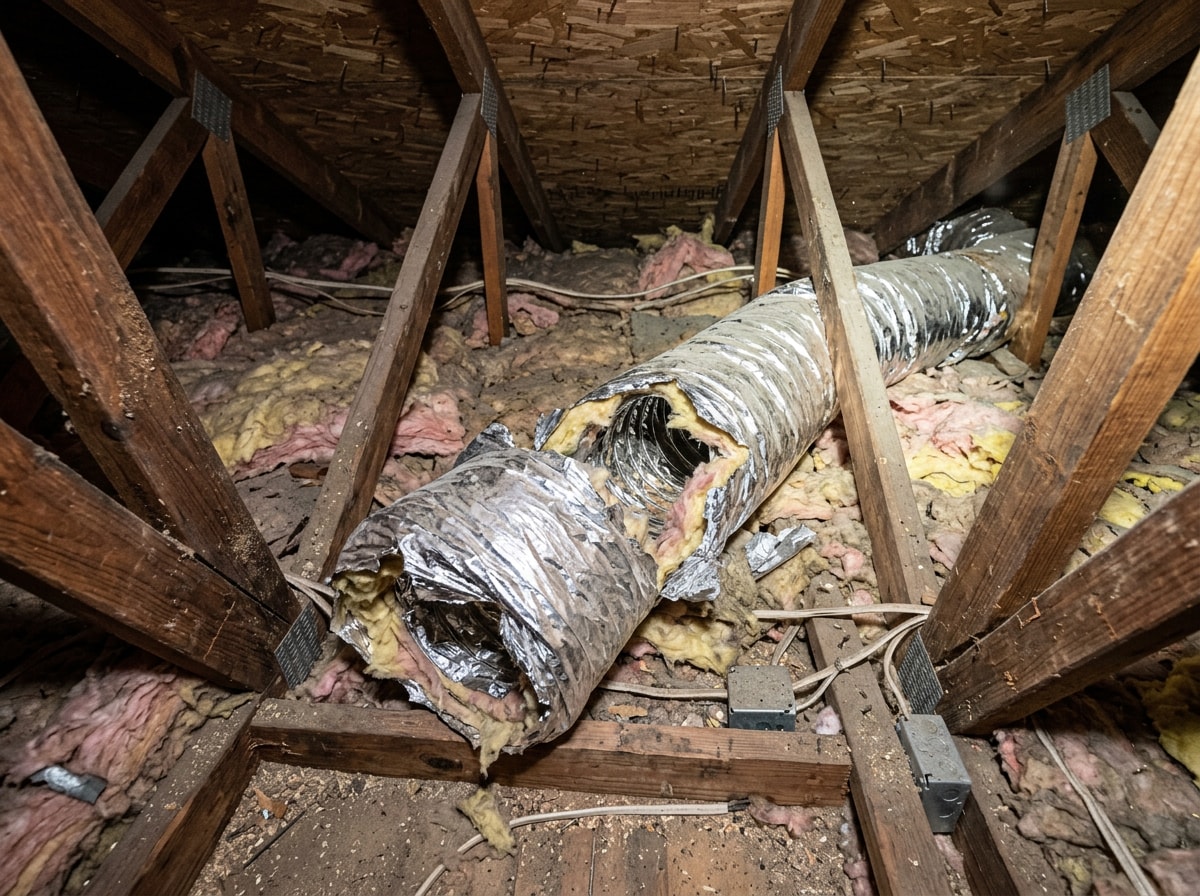
The clearest signals are simple to spot:
- Uneven temperatures between rooms or floors
- Weak airflow at the registers farthest from the air handler
- Energy bills climbing with no change in usage
- Visible dust puffing from vent faces
- Rattling, whistling, or booming inside the runs
Do three quick checks before you call anyone. Hold your hand to a register in the farthest bedroom and compare it to one beside the air handler. Note the gap between your upstairs and downstairs thermostats on a hot afternoon. Then look at exposed runs for crushed flex, sagging insulation, or joints that have pulled apart.
One caveat worth repeating: a clogged filter or a failing blower motor produces several of the same symptoms. The checklist is a reason to book an inspection, not a diagnosis. If the equipment is the suspect, start with air conditioning repair or heating system repair.
Replacement vs. New Duct Installation
Replacement usually makes sense when the system passes roughly 20 years, when you can see rust or separated sections, when airflow complaints survive repeated equipment repairs, or when dust persists after cleaning. Past that point, patching every season costs more than rebuilding.
New installation is a different project entirely. Oyster Bay homes converting from radiators, baseboard heat, or window units to central air or ducted heat pumps have nothing to replace. The work is designing a distribution system around existing framing, closets, and soffits.
There is a middle path. Removing failed runs while sealing and reusing a sound trunk line is legitimate when the budget is tight and the metal is still good.
Salt air matters here too. Coastal exposure near the harbor is hard on fasteners, hangers, and any exposed metal at the condenser end, so ask what hardware a bidder specifies. Explore HVAC installation options or check coverage for Oyster Bay, NY and Nassau County, NY.
Why Duct Design Decides System Performance
Your equipment only performs as well as the system distributing its output. A high-efficiency air handler pushing conditioned air through crushed flex and open joints is heating the attic.
In typical homes, about 20 to 30 percent of the air moving through the duct system is lost to leaks, holes, and poorly installed ducts.
The Department of Energy notes that ducts leaking heated air into unheated spaces can add hundreds of dollars a year to heating and cooling bills, and that sealing and insulating reduces that loss. The DOE's page on minimizing energy losses in ducts is worth ten minutes before you spend five figures.
Leakage shows up in predictable ways. Distant rooms never catch up. The blower runs longer and strains the motor. Return leaks in a dusty crawl space pull debris into your living space. Sharp turns and undersized trunks turn into whistles and bangs.
Once the system is in, keep it balanced with scheduled HVAC maintenance.
What Installation Week Actually Looks Like
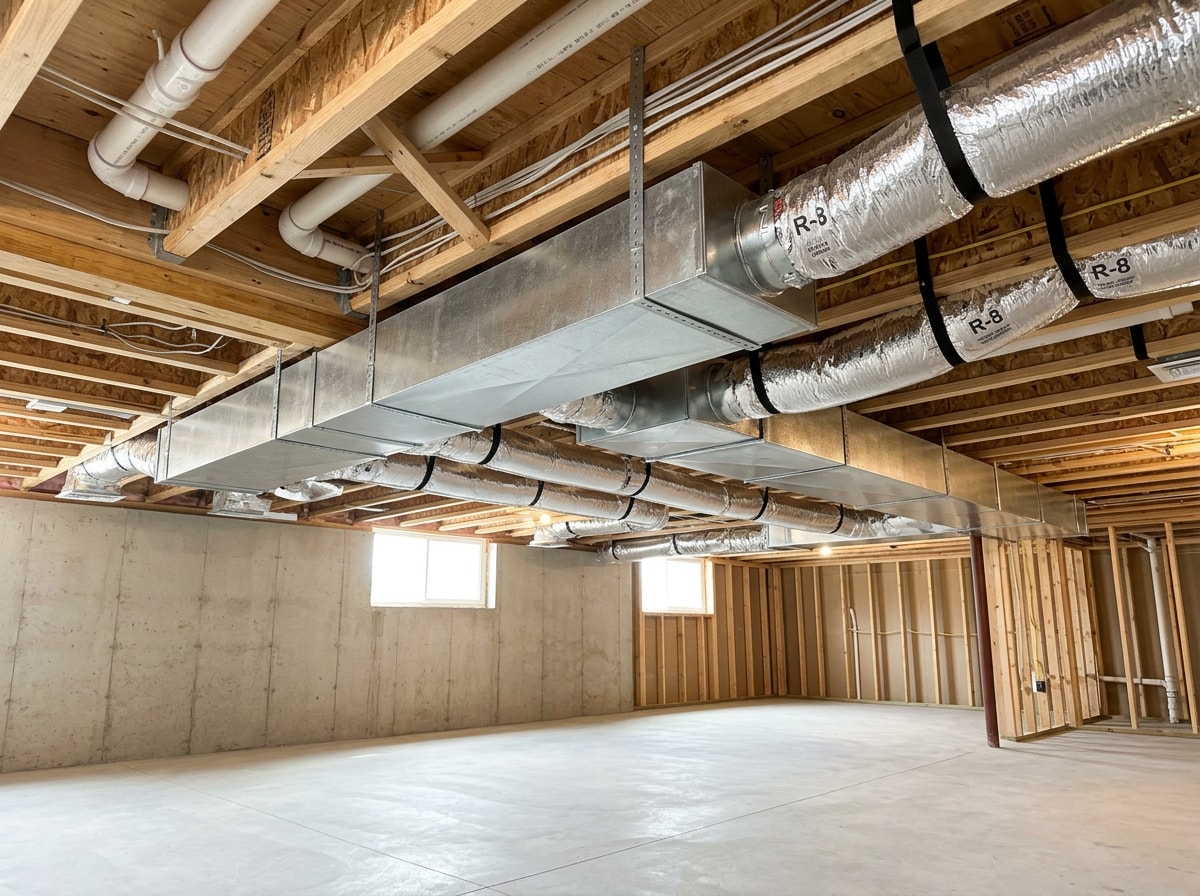
A typical whole-home duct project in a Nassau County house runs two to five days:
- Day one: protection, demolition, and removal of old runs
- Day one to two: trunk line set and plenum fabrication
- Day two to three: branch runs, boots, registers, and returns
- Day three to four: sealing, insulating, hanging, and support
- Day four to five: balancing, startup, and Town inspection scheduling
Attic-only jobs in July slow down for heat. Multi-zone layouts and custom fabrication add a day. If the heat or cooling is down while work is in progress, emergency HVAC service can bridge the gap.
FAQ
How much does ductwork cost for a 2,000 square foot home in Oyster Bay?
Plan on roughly $5,000 to $12,500 installed in 2026, depending on material and access. Sheet metal trunks with insulated flex branches sit toward the upper half of that band. Attic-only routing pushes it higher.
Do I need a permit to replace ductwork in the Town of Oyster Bay?
Assume yes and confirm with the Building Division. The Town's contractor portal handles permit entry, fee payment, inspection scheduling, and results , and residential and commercial A/C and HVAC unit work falls under categories requiring a certificate of compliance . Your installer should pull it, not you.
How long does ductwork last?
Most systems last 20 to 30 years. Galvanized sheet metal often reaches 25 to 40 years, while flex and duct board typically last 10 to 20. Attic heat, moisture, and installation quality drive the real number.
How long does a residential duct installation take?
Two to five days for most whole-home projects. Tight attics, custom fabrication, and multi-zone layouts stretch that. Add scheduling time for the municipal inspection after rough-in or completion.
Can ductwork be replaced without tearing open walls and ceilings?
Often, yes. Crews work through the attic, basement, closets, and existing chases wherever possible, and high-velocity small-duct systems were designed for exactly this problem. Expect some targeted drywall patching at boot and register locations.
Why does attic duct installation cost more than basement work?
Three reasons: access in a low, truss-filled space, summer temperatures that slow crews to half speed, and heavier insulation requirements for runs outside the conditioned envelope. Crawl spaces carry similar penalties, though attics are usually costlier.
Is sheet metal or flexible duct better?
Sheet metal for trunks, insulated flex for short branch runs. Metal lasts longer, cleans better, and holds its shape. Flex is cheaper and easier to route, but it kinks, sags, and loses airflow when installed carelessly.
Can I install ductwork myself?
Not a full system. Incorrect sizing, poor routing, and loose seals cause condensation damage, comfort complaints, and early equipment failure. Permit and inspection requirements make professional installation the practical route.
Get a Duct Quote from a Local Crew
If your house has rooms that never catch up, or no ducts at all, the next step is a site visit and a real load calculation. Our team works across Oyster Bay, Nassau County, and Long Island every week, pulls the Town permits, and fabricates what the framing actually needs.
Get a free estimate and we will walk your attic or basement before quoting a dollar.
Reviewed by the Amonte HVAC installation team, licensed and insured HVAC contractors serving Oyster Bay and Nassau County. Questions on a specific duct layout? Reach us through our contact page.